

I have a new piece up at The UnPopulist covering the vast scope of Trump administration corruption and its culture of corruption.
This is one of the major themes I want to cover as we head toward the midterm election results on Tuesday. (I talk about getting the results on Tuesday, because more than 40 million votes have already been cast.) The four big themes leading into this Election Day are the abuse of presidential power, which has long been my main focus, and I wrote about it again recently. Corruption is second, and I’ll say more about that below.
Next up, I am writing about how the current election reflects our “post-truth” politics, dominated by outright lies and gross fabrications. The last issue I’ll be covering is what I call the eternal recurrence of Trump’s first impeachment, the way in which this administration consistently treats the foreign policy of the United States as an instrument for gaining advantage in domestic politics. Those two overviews are coming up, so stay tuned.
I am also preparing for the post-election task of trying to talk Democrats into reining in excessive presidential power rather than preserving it so their own guy can use it. That’s going to be a monumental task, which is why I am asking for your support.
Underwhelming Bananas
This all assumes a “Blue Wave” on Tuesday, in which Democrats make big gains in Congress and acquire the votes necessary to serve as an effective check on Donald Trump. Let’s check in one last time on what the polls are telling us to expect.
The first thing to remember is that the polls are never completely right—nor are they ever completely wrong. They always have a margin of error. Pollsters can only sample a tiny portion of the voters, and they have to weight the results to be representative of who will actually turn up at the polls. But nobody really knows who’s going to turn up at the polls, so they have to make their best estimate.
For poll analysis, I’ve been recommending the Strength In Numbers newsletter run by G. Elliott Morris, and one of the things I like about him is that he is very honest and transparent about these uncertainties in the polling. In one of his recent posts, he describes “every way the polls could be wrong,” and better yet, he estimates how big an impact each of these errors could have.
The New York Times provides a similar analysis.
My favorite error is this. Many of the polls ask people who they voted for in the 2024 election, so they can weight their responses accordingly for this election. But four to five percent of the people who voted for Trump don’t remember (or don’t want to remember) that they voted for him, so they answer that question wrongly. This could cause polls to assume that Republicans are retaining more of their 2024 voters than they really are, which could lead them to under-estimate support for Democrats.
The upshot is that on average, the polls are off by a little over three percentage points. And that’s on average. In some elections, they have been off by five or eight points. And we don’t know what direction they are off until we see the results.
The polls right now strongly favor Democrats, showing them winning or in striking distance of winning in many places where they would not normally be competitive, like Texas and Iowa. But if the polls are off by three points in one direction, we could see an underwhelming night for Democrats—still a victory, but not a ringing mandate. If they are off by three points in the other direction, a night that is already good could turn into a rout. We could see a result that everyone seems by general agreement to be describing as “bananas.” The kind of night where we’re waiting up to see results in places like Mississippi and Louisiana.
So that’s the range, from underwhelming to bananas.
Personally, I’m hoping for something more on the “bananas” end. It’s not because I like all the Democrats, though winning in a bunch of “red states” would have the advantage of bringing more moderate Democrats into Congress, because you pretty much have to be a moderate to run in those places. But I think it would be good for this election to be felt as a shocking rebuke to Republicans—not just a massive public rejection of what they currently stand for, but a rejection that is broad and nationwide, even in the places they regard as their heartland. From that perspective, the more cataclysmic the result, the better.
Beyond the polls, we can see a few more indications that this could be where we’re headed.
Charlie Cook of the respected and usually cautious Cook Political Report describes this as a “unicorn election.”
Next Tuesday will be a unicorn election, certainly unlike any of the 11 midterm and 11 presidential elections I have covered. The dynamics are fundamentally different. The most critical segment is not “pure independents.” Nor is it “soft Democrats” or, for that matter, “soft Republicans.” Furthermore, unlike many elections, it doesn’t hinge on the behavior of swingy suburban voters.
Instead, the critical group in this election consists of normally reliable Republicans.
Another bad sign is that Trump himself is in a bubble of denial, unable to adjust to these changing circumstances and unwilling to allow other Republicans to adjust.
Many GOP candidates in tight races have tried to distance themselves from Mr. Trump’s policies, his behavior and the widespread allegations of self-dealing in his administration. Behind the scenes, some political advisers and outside Republican groups have warned the president’s aides that Mr. Trump could do more harm than good by holding rallies in battleground states with uncomfortably close races, according to people with knowledge of the conversations.
But the president, under pressure and angry with naysayers, has dismissed polls that reflect his unpopularity, and has raged against unflattering stories that plunge him into a dark mood. Determined to win by turning the midterm season into a referendum on himself, he is set to headline rallies around the country all week.
The biggest sign I see is that some conservative media outlets are beginning to engage in small acts of rebellion against the party line.
See a brilliant little piece at National Review describing “25 Things Democrats Might Do If They Retake Power.” All of them sound really terrible, like “Blowing out the national debt on a party-line vote that bypasses the Senate filibuster,” or “Targeting political enemies with selective and pretextual prosecutions.” But the gag is that if you follow any of these links, you will find a description of what Donald Trump and Republicans have already done.
Rich Lowry, who runs National Review, is a guy who knows how to stick his finger in the air and make sure he blows with the prevailing wind. When conservatives were against Trump, he was against Trump. When they reconciled themselves to nationalism, he reconciled to nationalism. So if he’s publishing stuff like this, that gives us an idea where he thinks the wind is blowing now.
We see a similar warning posted at another conservative outlet, the Washington Examiner, about a “MAGA bubble” in which “loyalty without limits bred arrogance and corruption.” “At the midpoint of Trump’s second term, the MAGA movement has lost all sense of how it is perceived by normal people.” This is still largely couched in terms of “perception” rather than reality, but it’s a start.
Between the polls and the behavior of politicians and commentators on the right, we’re getting a clear indication that the public is about to reject and rebuke the very thing they foolishly voted for two years ago.
If we ask why and what happens next, my article on corruption tries to provide some answers.
The Economics of Authoritarianism
My new article is partly an answer to an article The UnPopulist published a few days earlier. In that article, Gary Winslett notes that Democrats are trying to combine the issue of corruption with their rhetoric about affordability, and he argues this will not be enough. We can’t lower prices just by cracking down on corruption. “The appropriate solution is to increase the supply of housing, energy, and health care. Subpoenas can’t substitute for supply.”
I agree with that and think it’s a valuable point to make. But I wanted to provide a broader perspective on the role of corruption in a society. My main point is that corruption on this scale is no longer just a scandal. It is a fundamental change to our economic system.
Authoritarianism is never just a political system. It is also an economic system, built on corruption. Corruption is both a means and an end for the regime. For a lot of the people who jump on the bandwagon of an authoritarian regime, the whole purpose of grabbing power is to get rich from insider deals. But this also serves a practical purpose for the strongman, who consolidates his regime by feeding his supporters and starving his opponents.
My article was published yesterday afternoon, and this morning, I saw an article at the New York Times on the vast network of Trump administration corruption and the “princelings” who siphon off wealth from it. It’s worth reading, but it describes this as “a new strain of American capitalism.” This is a fundamental misunderstanding of the whole history of capitalism.
For much of the 20th Century, people viewed the two alternative economic systems as capitalism versus socialism. They forgot that capitalism first arose in opposition to a different alternative. Here’s how I put it.
The economics of right-wing authoritarianism is not a free market, nor is it socialism. It is a return to what came before capitalism: feudalism and aristocracy, with its network of patronage built around the political power of men from established families.
That’s why I regard the current scope of corruption as important. It is a retrogression to a “neo-feudal economics of patronage.”
Someone will inevitably ask why I didn’t complain about corruption under Democratic presidents, and of course I did. But I’ll give the same answer I give about abuses of presidential power: Everyone has done it, but not at this scale, and there’s a point at which a difference of degree becomes a difference of kind. Trump isn’t just doing a little corruption behind the scenes. He’s doing it openly and brazenly at a scope that is making it into our prevailing economic system.
In this article, I could only give a limited number of examples, and I’ve been saving more of them. Here are a few more highlights:
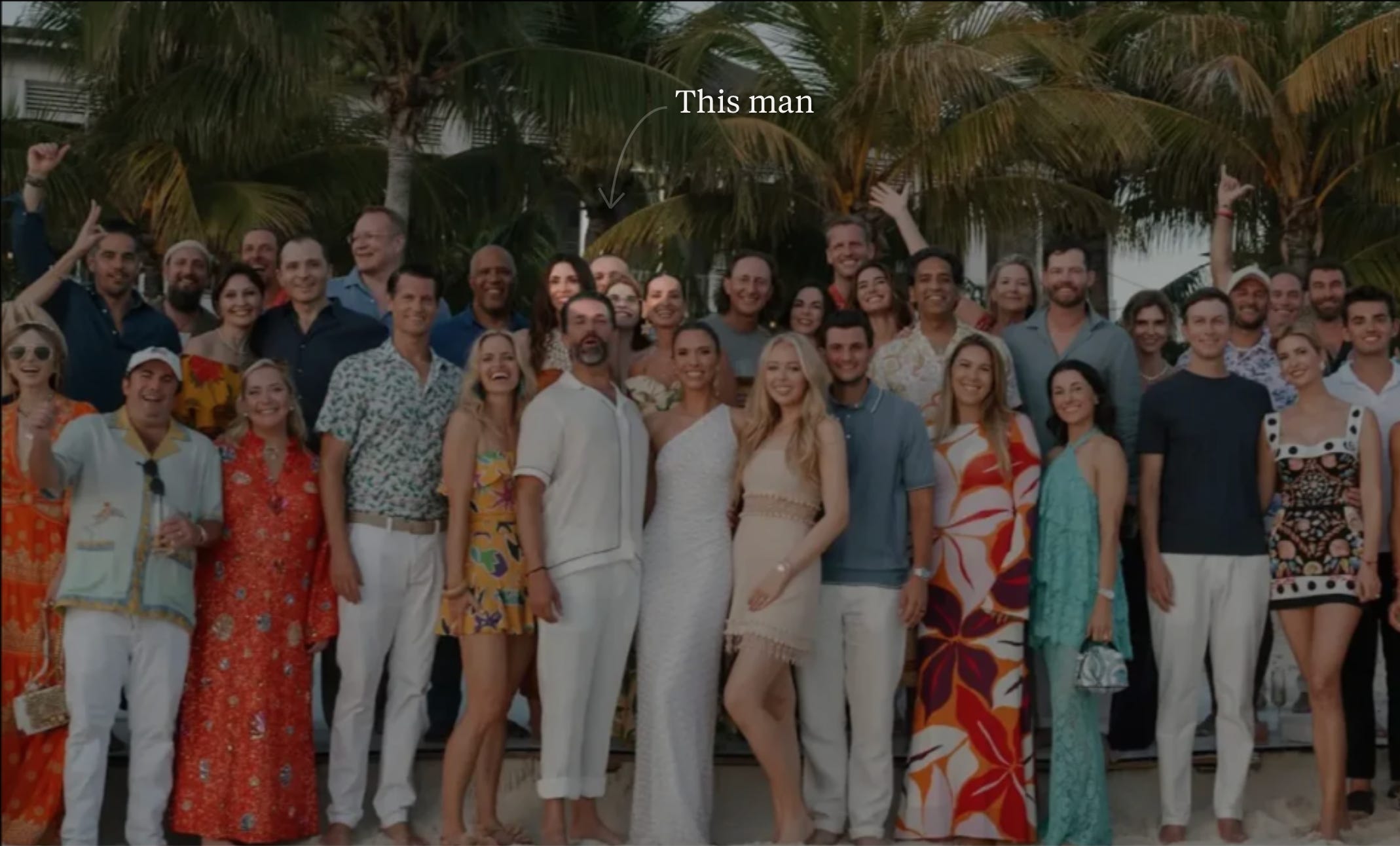
There’s the Russia oligarch and Putin crony who paid for Donald Trump, Jr.’s lavish three-day wedding party on private islands in the Bahamas.
There’s Robert F. Kennedy, Jr., getting free flights to Fiji and Greece from a political donor.
There’s the leak of a secret list of donors to Trump’s ballroom project, which includes a collection of big companies with business and regulatory interests that depend on the administration’s friendship.
To combine economic corruption with political corruption, we have Trump quashing an FBI investigation into Maine Senator Susan Collins for funneling illegal campaign contributions from a defense contractor in exchange for promises of government contracts.
Finally, there is Trump’s general amnesty for white collar crime, including letting con-men off the hook for as much $1.7 billion owed in restitution to victims of fraud. And he is even dismantling the infrastructure that allows the government to spot and prosecute crimes, illegally deleting a registry of shell-company ownership that is used to track money laundering.
Changing America’s economic system is going to cost us. Check out an article by two scholars who examine the record of authoritarianism and sketch out how it is bad for the economy. Their main conclusion is particularly relevant right now.
Our study found one condition that allows economies to thrive even when democracy is in decline: functioning political parties in independent legislatures.
That leads us back to Tuesday’s election. I argue that the issue of corruption provides something important and substantive that a new Congress can do.
[T]his gives Democrats an opportunity precisely suited to the power they will have if they retake a majority in Congress. A promise of pardons can stop the federal prosecution of corruption, but it cannot keep Congress from investigating and holding hearings to expose one of these schemes after another. This is what [Georgia Senator Jon] Ossoff has been promising: “If you’re involved in any of this, next year, you’ll be raising your right hand and swearing to tell the truth, the whole truth, and nothing but the truth, so help you God in front of the United States Congress.” A congressional majority battling with a hostile president may not easily be able to pass big legislation—but no one can stop it from holding hearings to expose massive corruption.
I also point out how this is an opportunity to build the political capital for some of the big reforms we’re going to need.

The Inner Light
Almost as a contrast to all of this comes the news of the death of Patrick Stewart, the beloved Shakespearean actor who is probably best known to Americans—or at least to this American—as Captain Jean-Luc Picard in the Star Trek franchise. He had an outsized influence on the culture as a fictional model of a man of thoughtfulness, courage, and integrity—which, to all reports, matched his off-screen reputation as a mentor and benefactor. That’s definitely an example we could use right now.
I can’t view it as a tragedy when a man dies at the ripe old age of 86—or at 90, as with original series Star Trek actor Walter Koenig, who died a few days earlier. Rather, it’s an opportunity to reflect back on the artistic and personal accomplishments of his life.
In Patrick Stewart’s case, he played a role quite specifically in preparing us for how to confront death. I have in mind one of the all-time classic Star Trek episodes, “The Inner Light,” which I wrote about a few years ago.
The plot involves Captain Jean-Luc Picard’s encounter with an alien probe which puts him into a coma-like state, inducing a long hallucination of his life on another planet among a race of aliens whose sun exploded a thousand years earlier. In this hallucination, Picard has a family and friends and lives an entire life. The climax of the episode—I did give you a spoiler warning, right?—happens when Picard wakes from the hallucination—back on his ship—and discovers its purpose: the effort of a doomed people to leave behind some trace of themselves. As a virtual representative of the long-dead aliens tells him, “If you remember what we were and how we lived, we will have found life again.”
Patrick Stewart helped us meditate on the inner light and also helped spread a lot of light outward into the world. If we remember who he was and how he lived, he will have found life again.
How do you make sure your support for the Democrats does not translate to support for the DSA?
More scary is that so many of the Democratic candidates are also religious clergy, which is probably worse than electing MAGA people. When a candidate represents the opposite of the usual bent of his/her party is the most dangerous situation, i.e. Bush pushing the prescription drug benefit through, hate speech laws pushed by Democrats, etc.