

Since the end of my congressional primary, I’ve been thinking about my next steps, the next big project for this newsletter, and what most urgently needs to be done. I’ve come to a very clear answer.
In my recent article trying to find Democratic candidates who are campaigning against abuses of executive power, I mentioned that there is already a debate going on—for now, mostly in the background—over what to do about executive power. See this piece for the best quick summary of who stands where.
On the one side, there are those who want to keep the expansive, nearly unlimited executive power claimed by Donald Trump, so a future Democratic president can use that power to roll back Trump’s agenda and impose their own favored agenda. On the other side are those who want to restore limits on presidential power, who are urging Democrats to act vigorously to undo the damage created by Trump, but to do so within the limits of the Constitution and with the goal of restoring the Constitution.
You all know where I stand on this, but it is now a debate with a timeline. Democrats are likely to regain control of Congress in next month’s election, and if they do as well as they are projected to, they will be likely to win back the presidency in 2028. Within the next two years, we will all have to decide what we should do with the powers of Trump’s ultra-imperial presidency.
I can sum this up in one phrase, and anyone who knows the works of J.R.R. Tolkien already knows, from my main headline above, where I’m going with this.
We need the Council of Elrond. In fact, we’re already conducting such a debate without really identifying it.
When I first read The Lord of the Rings, about 40 years ago, a Tolkien reference like this would have been considered obscure and very geeky. Since then, Tolkien’s works have been turned into a series of blockbuster films and some television spinoffs, so it’s fair to say that Tolkien lore has entered the mainstream of the culture. For those who still find it a bit obscure, let me explain. And yes, this will all be relevant—surprisingly and insistently relevant—to today’s politics and the future of every one of us.
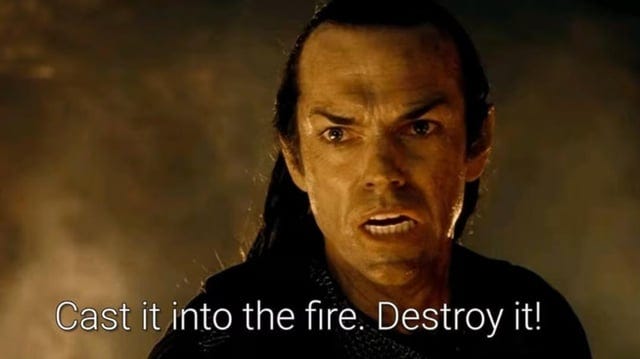
Here’s the very short version. In Tolkien’s story, the good guys have discovered a magical “ring of power” lost long ago by a sort of evil sorcerer, and they have to decide what to do with it. The Council of Elrond is the name Tolkien gives to this debate. There are two alternatives. A somewhat hot-headed warrior declares that they should use the power of the ring for good, to defeat their enemies. But the wisest at the Council prevail, arguing that the ring is “altogether evil,” that any attempt to use it for good would be twisted toward evil ends, and so it must be destroyed. But destroying the ring is extremely difficult and dangerous, and the rest of the debate is over who is going to do it and how.
You can watch the movie version of that scene here.
The purpose of art and fiction is to help us work through the real issues we encounter in real life—and that’s no less true for stories set in a quasi-medieval fantasy world with wizards, elves, and goblins. The ring of power is a metaphor for power as such, particularly for tyrannical power and the lust for power. The ring is a metaphor for the idea that power corrupts.
I think you can see the relevance of that metaphor today. We are already acting out the Council of Elrond in real life. Instead of debating what to do with a ring of power, we’re debating what to do with excessive executive power. Do we rein it back within its proper constitutional limits, or do we delude ourselves into thinking we can harness authoritarianism for good?
That’s the discussion I’m gearing up for, and not just in a general way. I have a specific idea for implementing this.
The first phase is that I am making plans for a new podcast series called The Council of Elrond, carried out under the banner of my Symposium newsletter. The idea is to interview various experts on the law, the Constitution, and American history about why we should rein in executive power and how to do it. What specific reforms do we need? How does that integrate with vigorous action to roll back the abuses of the Trump era? How do we avoid the passive, Biden-era return to norms of liberal self-restraint that just ended up empowering the authoritarian right? (And is that really what happened?)
I have many ideas of my own on these subjects, but I want to take advantage of the knowledge and ideas of a wide range of experts. I will interview them and share those conversations with my subscribers here and at Symposium.
The second phase is to turn these insights into a series of articles, and then a book, that is a follow-up to my book from last year, Dictator from Day One. The purpose of that book was to raise the alarm about out-of-control executive power. The purpose of this new book will be to chart the course back to a liberal constitutional order. But it will have a broader purpose. My working title is Militant Liberalism, and I will address the broader question of how to create a pro-freedom, pro-democracy political creed that is strong, assertive, and capable of defending itself, while still being liberal. It is about reclaiming a vision for a political system that can be strong without being tyrannical.
This is hardly an impossible combination. We’ve managed it through most of America’s history. We just need to learn the lessons from that history and apply them to today’s conditions.
Now here is where I’m asking for your help.
I need your support to give me the time and resources I will need to conduct these interviews and write these articles—to crowdfund this whole project, as I have often done.
And it will also give me time and resources for the third phrase, which is to use some of the contacts and the skills I gained running for office to try to draw more people into this debate and exert influence on those with actual political power. If you’ve been reading my series about what I learned running for office, you know that I expect most actual officeholders, not to do what is right, but to do what the political forces around them push them to do. Hamiltons and Madisons and Jeffersons are not all that easy to find these days. But I think we can shape some of the forces of public opinion that act on these elected officials and get some of them to do what is best for the republic whether they want to or not.
That’s the goal, the timeline is to start right away with the goal of having the new book early next year and influencing this debate—our national Council of Elrond—in 2027 and early 2028, when these big decisions are being made.
I raised a little more than $50,000 for my political campaign. I’m hoping to raise at least half that for this project. I’m hoping you will give me your support.
(You can also send a check by mail to The Tracinski Letter at PO Box 6997, Charlottesville, Virginia 22906.)
And of course, you can always support these efforts just by subscribing or renewing.
You might say I’m forming a fellowship for this quest, and I’d like you to be part of it.