

I have a new piece up at The UnPopulist looking for an “Article I candidate”—someone who is up for re-election this year who is really addressing the abuse of executive power and how Congress can rein it in.
That is, of course, what I was attempting to do, but since I didn’t make it through the primary, I’ve been casting about to find anyone else who is really addressing these issues. When The UnPopulist asked me to write something about it, I jumped at the opportunity. But I found a curious pattern.
I review a number of actual proposals for limiting presidential power, none of which are quite as big as we really need, but at least they are real, substantive legislation. Yet “there is a pattern you might notice about these proposals.”
[Senators] Murphy and Schiff are not up for reelection this year. Raskin, DelBene, and Beyer—and many others who are backing these proposals—are in safe Democratic districts that are even safer than usual this year. If you want to predict how loud a politician is about proposing bold restraints on executive power, look at who is in the “Solid D” column in the Cook Political Report.
In short, Democrats in competitive races are playing it safe and sticking to the conventional wisdom about affordability and gas prices, while Democrats in safe seats are more likely to talk about big reforms.
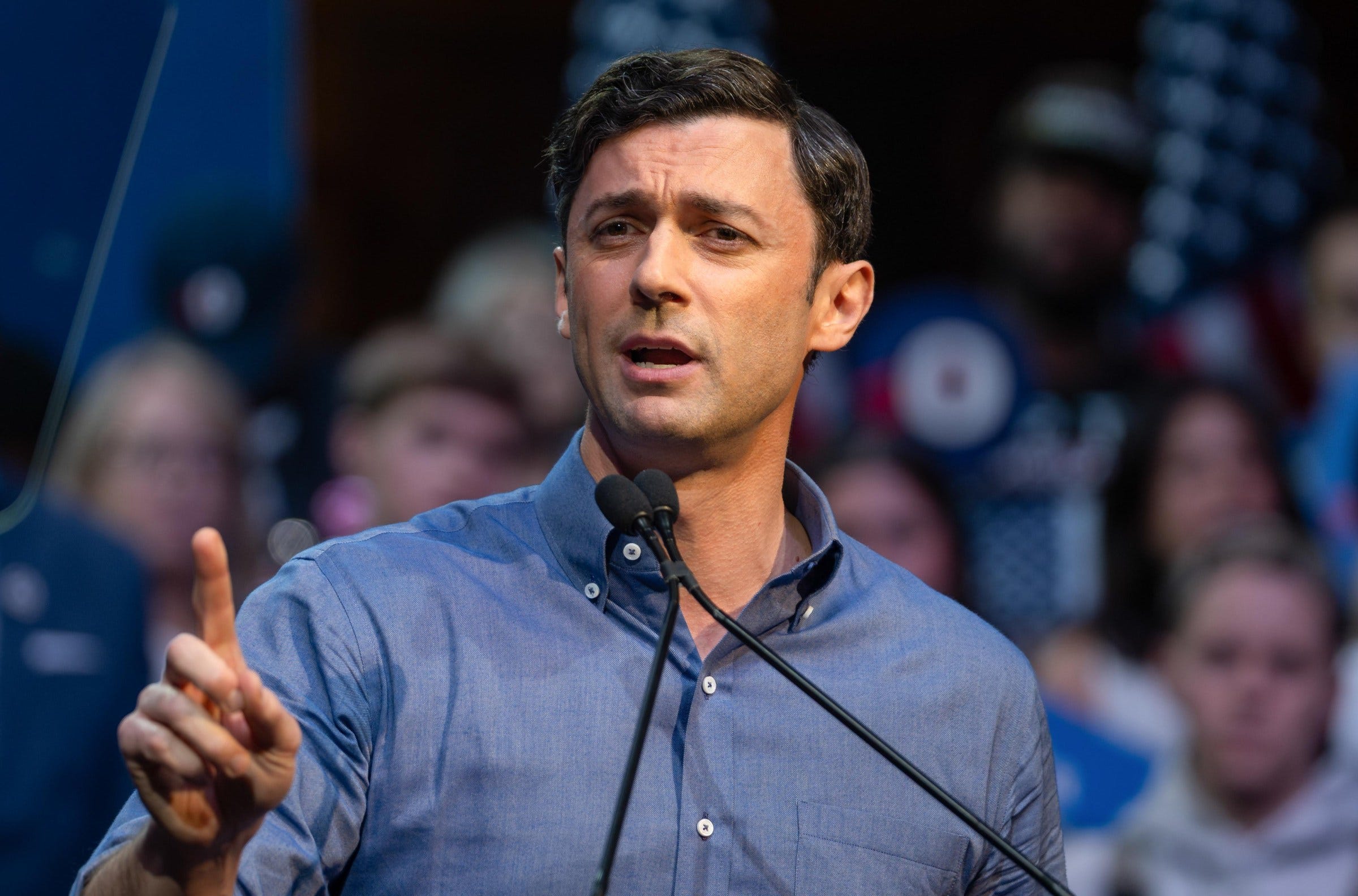
I then settle on one semi-exception: Georgia Senator Jon Ossoff. He’s running for re-election, not in safe seat, but in a race where he’s clearly ahead. And he’s running partly on curbing executive power.
Ossoff got a lot of attention for a strong debate performance last week in which he laid into his opponent for his ties to white supremacists (which are real). But I pull out a better message he’s been repeating on the campaign trail.
Ossoff has called for a restoration of checks and balances. At a rally this summer, he told voters that the issues in this election are “deeper than the ordinary conflict of policy and ideas between two political parties.” He urged them to “rebuke these presidential abuses so decisively that we don’t just restore checks and balances for the next few years, we send a message so that no president in either party will try anything like this again for centuries, for centuries. That’s the opportunity that we have.”
This is exactly the right message and agenda. This is what we need.
The most interesting thing about Ossoff is that he is considered a moderate senator who was expected to tack to the center in a reelection campaign. Vice President JD Vance even predicted last year that Ossoff would begin praising Trump’s agenda. Instead, Ossoff has employed fiery invective against Trump’s abuses to gain support across the board. It’s a message that can unite and energize Democrats across their internal progressive-versus-moderate divide, while also appealing to independents and disgruntled Republicans. He has demonstrated that a campaign against Trump’s abuse of power has broad appeal.
Most interesting of all is that Ossoff was already being widely talked about as a possible Democratic presidential candidate for 2028, even before his recent debate performance. This shows that campaigning against abuses of executive power can become an established lane for ambitious politicians wanting a shot at being elected to wield executive power.
This raises the question, which I’ve already had a few people ask me, about who looks like the best Democratic candidate for president for 2028—but it’s too early. That’s a good topic to return to next year, after the election and after the new Congress actually takes office.
And I don’t want to get carried away here. Ossoff is making this part of this message, but I would like it to be a more dominant part. And he is, after all, a politician, so I will give him the highest praise I give to any politician: I’m really looking forward to finding out how he will disappoint me.
“Energetic Constitutionalism”
The main point is that we need somebody talking about limiting executive power, partly because there is already a debate going on quietly among Democrats about whether to rein in the excessive powers Trump has claimed—or use them for the Democrats’ own agenda.
Check out a good roundup of the range of opinions on this. On the one side are sensible people like Chris Van Hollen and—er, Ro Khanna? OK, Ro Khanna is not a sensible person, but he is saying the right thing here, describing “the ideal approach to post-Trump executive power as ‘robust action within the Constitution,’ which he calls ‘energetic constitutionalism.’” On the other side is Elizabeth Warren, who complains, “We can’t play the game that Republican presidents get lots of power and Democratic presidents don’t.” This is exactly what I expected of her, and it’s madness. It’s a race to the bottom.
I will, obviously, have a lot more to say on this, but for now, I provide part of the rebuttal in my article.
Democrats should heed the warning from the recent election in Brazil, where Flávio Bolsonaro, the son of a former president convicted of plotting a coup, might well be poised to win the presidency. It is a reminder that even as the voters reject Donald Trump, they might swing back again toward a future strongman leader with the same agenda. Democrats need to think ahead and place firm limits on presidential power while they can, making it harder for successors to do what Trump is doing now—even if that means rejecting the temptation to use these illegitimate powers for their own agenda.

We need to be talking about this now, because if next month’s elections turn out how I think they will, Democrats might have a unique opportunity. If Republicans begin to realize that the voters have thoroughly rejected Trump and the people associated with him, they will look forward to 2028 and calculate that the next president is very likely to be a Democrat. If they’re remotely smart—which I realize is a big assumption to make—they should suddenly become a lot more interested in limiting executive power. This could give us a brief window in which Democrats have a political interest in restraining executive power to stop Trump, while Republicans also have a political interest in restraining executive power as a preemptive protection against President Newsom.
I hope we can find a few politicians who are interested in using that opportunity.