

The midterm election results are (mostly) in, and as predicted, it was a reckoning for Donald Trump and for a Republican Party he reshaped around total loyalty to himself and his agenda.
You’ve already seen the topline results. So far, Democrats have gained about 40 seats in the House, for a majority of 246 seats, as of this evening—but there are still a few dozen uncalled races, so that number is going to rise. The new House majority may be more like 260. That’s a full-on legitimate wave election, on the scale of the Republicans’ Tea Party wave in 2010, or perhaps more to the point, the post-Watergate Democratic wave in 1974.
The change in the Senate is more surprising, because people were being very cautious about projecting Democratic gains. Yet as of now, the Democratic majority is confirmed at 54 seats, and there are two Senate races still uncalled, in Alaska and—the big shocker—Mississippi.
Before the election, I noted that if the polls were off in one direction, it would be an underwhelming night, and in the other direction, it would be “bananas.” It turned out the polls were pretty much right—the worst outcome for those of us in the pundit business, to be honest.
With the exception of a few surprises—Mississippi!—most of the really bananas results did not materialize. I saw speculation, for example, that super-MAGA Florida Representative Anna Paulina Luna could go down, but she won by a very narrow margin—less than one point, with just under 50% of the vote, at last count.
Yet there is one very big and significant change, and that is Texas.
I contributed to a post-election roundup at The UnPopulist, and my observations focus on Texas, while I make only a passing reference to the surge in black turnout in the South, because I knew that Andy Craig’s contribution would focus on that.

I had to really shorten my contribution to fit in their format, so I’ll give you the longer version immediately below.
This Was a Civil Rights Election, Not an Affordability Election
The most extraordinary result last night was the complete reversal for Republicans in Texas.
For decades, Democrats have sought after “Blexas,” a “Blue Texas,” and they hoped to achieve some narrow wins there. Last night, the wins were not narrow. Democrats easily won every statewide election: senator, governor, lieutenant governor, attorney general—all the way down to railroad commissioner. (That may seem like an obscure race, but it gained salience because of the Republican candidate’s open and blatant racism, including a screed against Indian-Americans.) A mid-decade Texas redistricting was supposed to gain five House seats for Republicans, but they have so far ended up with one fewer seat than before. On the state level, Democrats look likely to gain a majority in the Texas House and significantly reduce the Republican lead in the state senate.
Texas is for Republicans what California is for Democrats: a large, populous state where they can rely on having a majority that allows them to conduct influential experiments and wield outsize influence. (Texas, for example, has a big impact on school textbooks because of the sheer size of its market. Control of the State Board of Education is now up for grabs.) This is like waking up one morning and finding California totally controlled by Republicans.
This isn’t just a loss of a few races, it’s a loss of the Republican heartland. On top of its practical effects, it will have a profound psychological impact.
Yet this was totally predictable. All summer, it was clear that Hispanic voters in Texas were moving against Republicans. According to a Washington Post analysis of exit polls, majority Hispanic counties nationwide moved toward Democrats by about 28 points. In Texas, they moved more than 33 points.
The secret of Republican control of Texas is that they can win only with significant support from culturally conservative Hispanic voters. If they lose this voting bloc, they can’t win in Texas, and it’s questionable whether they can win nationally—and they lost it, decisively and possibly for a generation.
It’s not hard to figure out why. Look at one of those New York Times travelogues where they interviewed Hispanic voters in border regions in Texas. What they found is that there were a lot of people who backed Trump because they still thought he was that businessman on TV who would be good for the economy, and because they thought he would only deport criminals and gang members. Then they found they had to start carrying their passports with them everywhere because they would be harassed by masked goons on the street, and they all knew people who had been harassed, imprisoned, even shot. They found themselves treated as second-class citizens in their own country.
That’s how we got an epic wipeout specifically in Texas.
While Hispanic voters made the big difference in Texas, this is part of a wider transformation of the South. Republicans lost ground in North and South Carolina, in Georgia, even in Mississippi, where the Democratic candidate for Senate currently holds the lead—by fewer than 100 votes, for a while there, but it’s still a lead, in a place where we would not expect it.
These results are partly due to surging black turnout, which is a response to overtly racist rhetoric and policies by Republicans, and more specifically to a Supreme Court ruling that effectively dismantled the Voting Rights Act of 1965 and allowed for blatant racial gerrymandering. As with the Texas gerrymander, this largely backfired. The anger among black voters drove them to the polls in large numbers.
That is my big takeaway from last night’s vote. This was not an election about “affordability,” it was an election about civil rights.
There was a deeply entrenched conventional wisdom among Democrats that voters don’t really care about Donald Trump’s abuses of power, they don’t care about his incursions on civil rights, all they care about is the economy and the price of gas. But that doesn’t explain the breadth and depth and the specific shape of last night’s result. Instead, this election looks a lot more like a repudiation of MAGA rhetoric about the superiority of white “Heritage Americans” and fantasies about deporting 100 million people—nearly one third of the US population, most of whom would have to be stripped of their citizenship. It was about black and Hispanic voters—and many white voters who support our friends and neighbors—demanding that they be treated with respect and viewed as equal citizens.
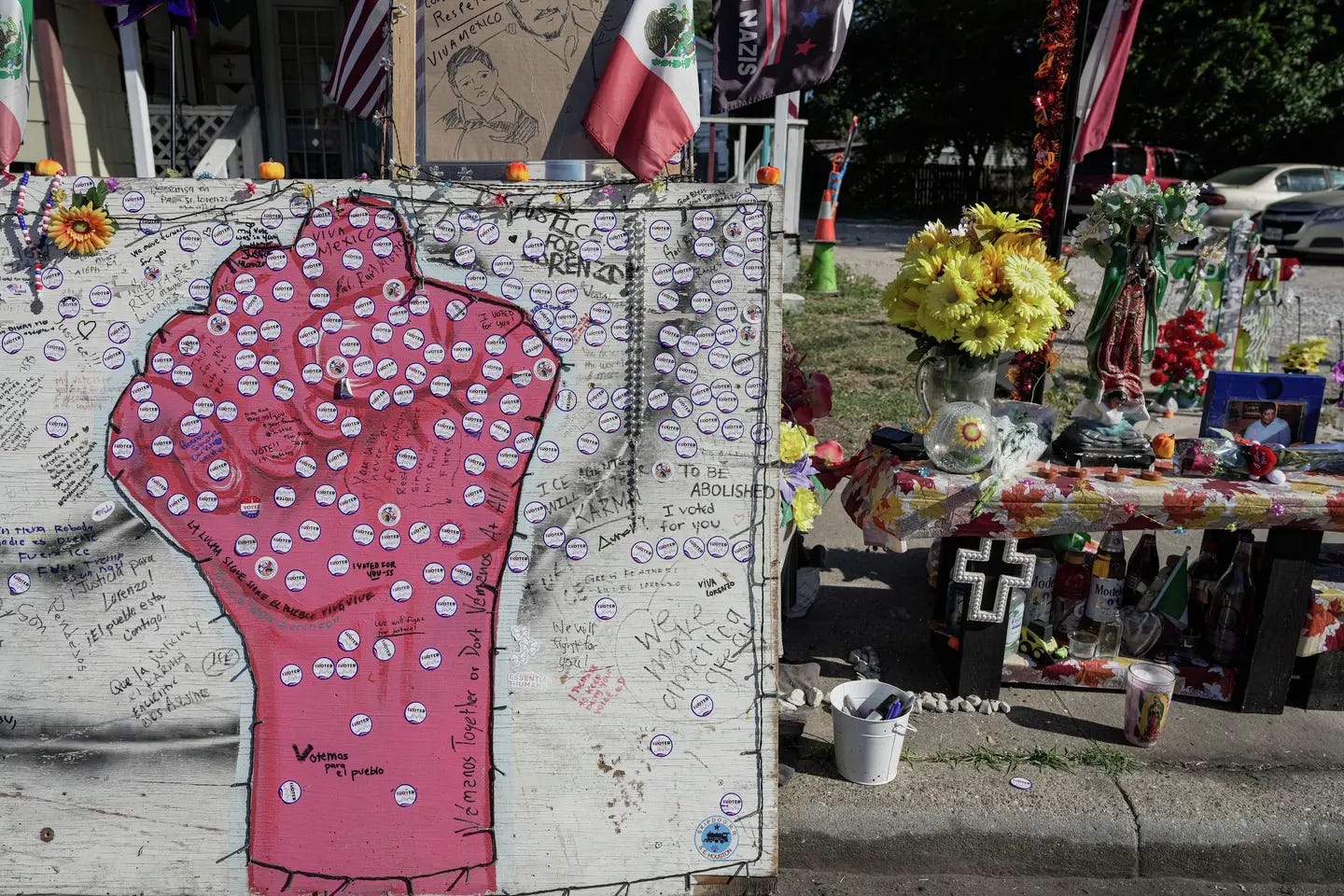
The symbol of this is a custom that began as early voting started. At memorials for victims killed by our new immigration police state—in Houston and of course in Minneapolis—people began posting their “I Voted” stickers. It’s a gesture that tells us exactly why they were voting and what they were voting against.
The reason I think this was the more powerful motive in last night’s vote is by contrast to the result in districts like my own, Virginia’s Fifth District, which runs from the urbane, sophisticated university town of Charlottesville down through a swath of ultra-conservative rural Virginia. In the last year, I ran in the Democratic primary for Congress here. It was perhaps a quixotic effort for a writer with no experience running for office, and I lost to an established local Democratic politician. He then ran a very straightforward “affordability” campaign focused almost entirely on a promise to bring down prices. But while the district moved significantly toward Democrats, in every county and locality, it didn’t move far enough, and he lost by about two points. This is a pattern repeated across the country, where many pro-Trump Republicans who are used to winning by more than ten points eked out narrow victories—but they still eked them out.
It’s entirely possible no other kind of campaign could have worked in the Fifth District, that there aren’t enough black and Hispanic voters here, and for every white liberal in Charlottesville who is hopping mad about ICE—and I talked to a lot of them—there is a conservative voter in a place like Appomattox County who thinks immigrants are getting what they deserve. I didn’t get far enough to really put this to the test. Either way, it’s clear that campaigning on affordability alone did not move the needle enough—not here, and not in a lot of districts. Yes, the price of gas hurt Trump and made many Democratic victories possible, but it was not enough to explain last night’s results.
This is a actually a heartening result. I’ve heard a lot of bitterness about the prospect that Americans wouldn’t vote against Trump because of his tyrannical policies or disregard for constitutional rights, that they would only vote against him if it inconveniences them economically. The midterm election result seems to show the opposite.
It gives us hope that the cultural forces that won the Civil Rights Movement are still alive and well, and we won’t all just bow down to a king because he hates the same people we hate. God bless America.1
Kakistocracy Versus Meritocracy
Shikha Dalmia’s contribution to that discussion raises another major factor in this election.
