

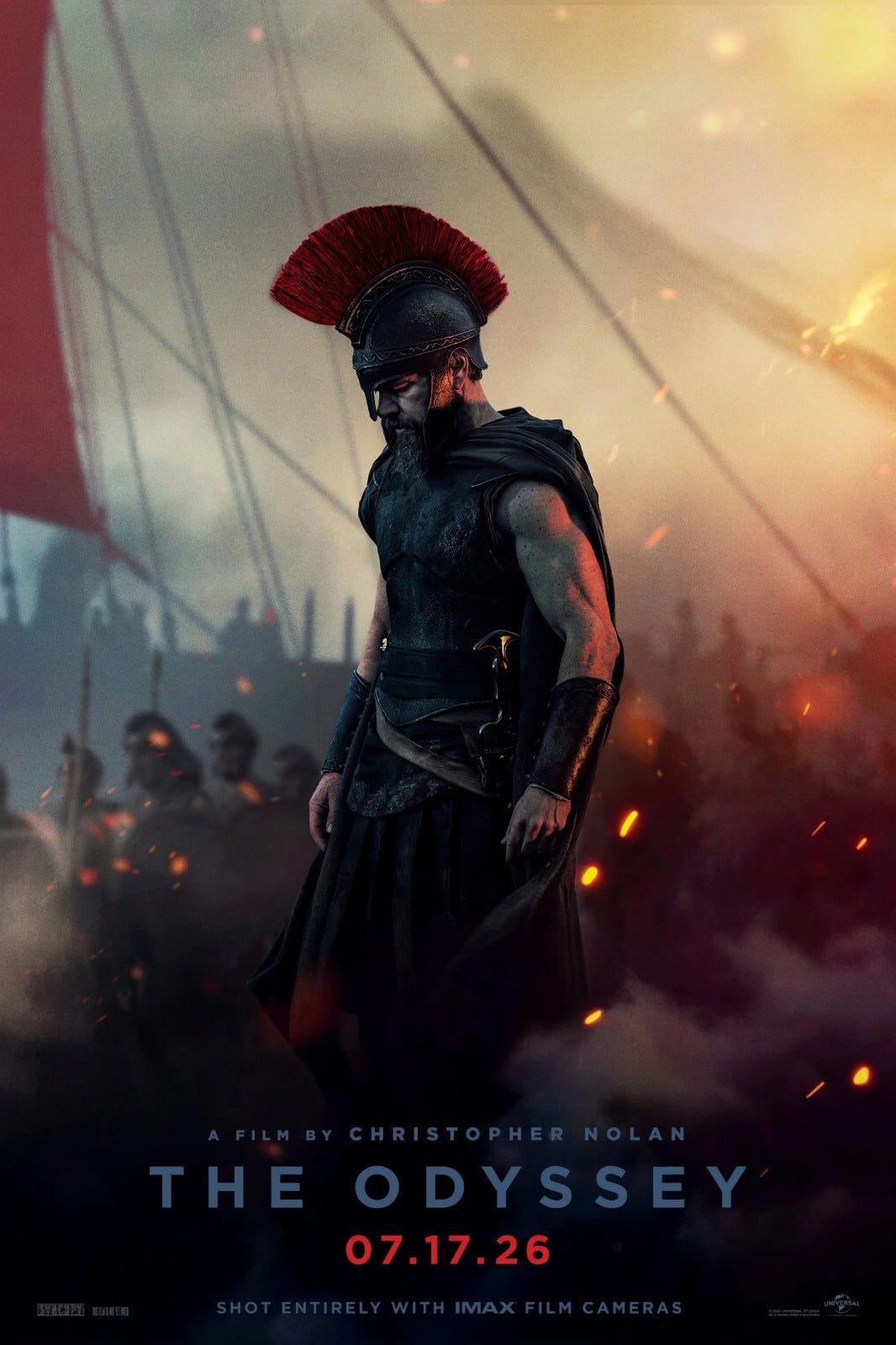
In what we are told is the streaming era, this epic is bringing audiences back to cinemas. In what we are told is a time of declining literacy and the “death of the humanities,” translations of The Odyssey, including mine, are flying off the shelves. Some of those who buy the book or show up in cinemas to watch Tom Holland may go on to study ancient Greek. Perhaps the film will persuade a few college administrators not to cut their literature, language, and history departments. Nolan, who studied English at University College London—where students still study The Odyssey as a first year “foundational text”—is doing his best to get the general public reading again, and I am grateful.
This is the gracious ending of Emily Wilson’s review of star director Christopher Nolan’s new film version of Homer’s Odyssey. (The rest was not so gracious, especially considering that Nolan has made Wilson a rich woman. More on that review in a moment.)
One of the compensations of this year is that amid some less edifying debates, everyone has been taking a little time this summer to debate the proper interpretation of a three-thousand-year-old Ancient Greek poem. I regret I haven’t had the time to participate before now, particularly because this new adaptation has a lot of relevance today.
For those who know their Ancient Greek history, I can describe the film in one sentence: Nolan set out to film The Odyssey and ended up filming the Melian Dialogue. For those who don’t know what that means, read on for an explanation.
But first, let’s deal with the earliest wave of controversy, a freakout among reactionary conservatives—there does not seem to be any other kind these days—over the film’s multiracial casting. Helen of Troy is played by the Mexican-born Kenyan-American actress Lupita Nyong’o. Athena is portrayed by Zendaya, whose father is a black American of Nigerian descent. Eurylochus, right-hand man to Odysseus, is portrayed by Himesh Patel, a British actor of Indian descent by way of Africa. Transgender actor Elliot Paige (formerly Ellen Paige) plays Achilles—no, scratch that. That was the rumor spreading around before the film launched, but Paige actually plays a young Greek warrior named Sinon (a character plucked from The Aeneid but never mentioned by Homer).
Even worse, they cast some pallid Northern European guy as the Greek hero Odysseus.
