

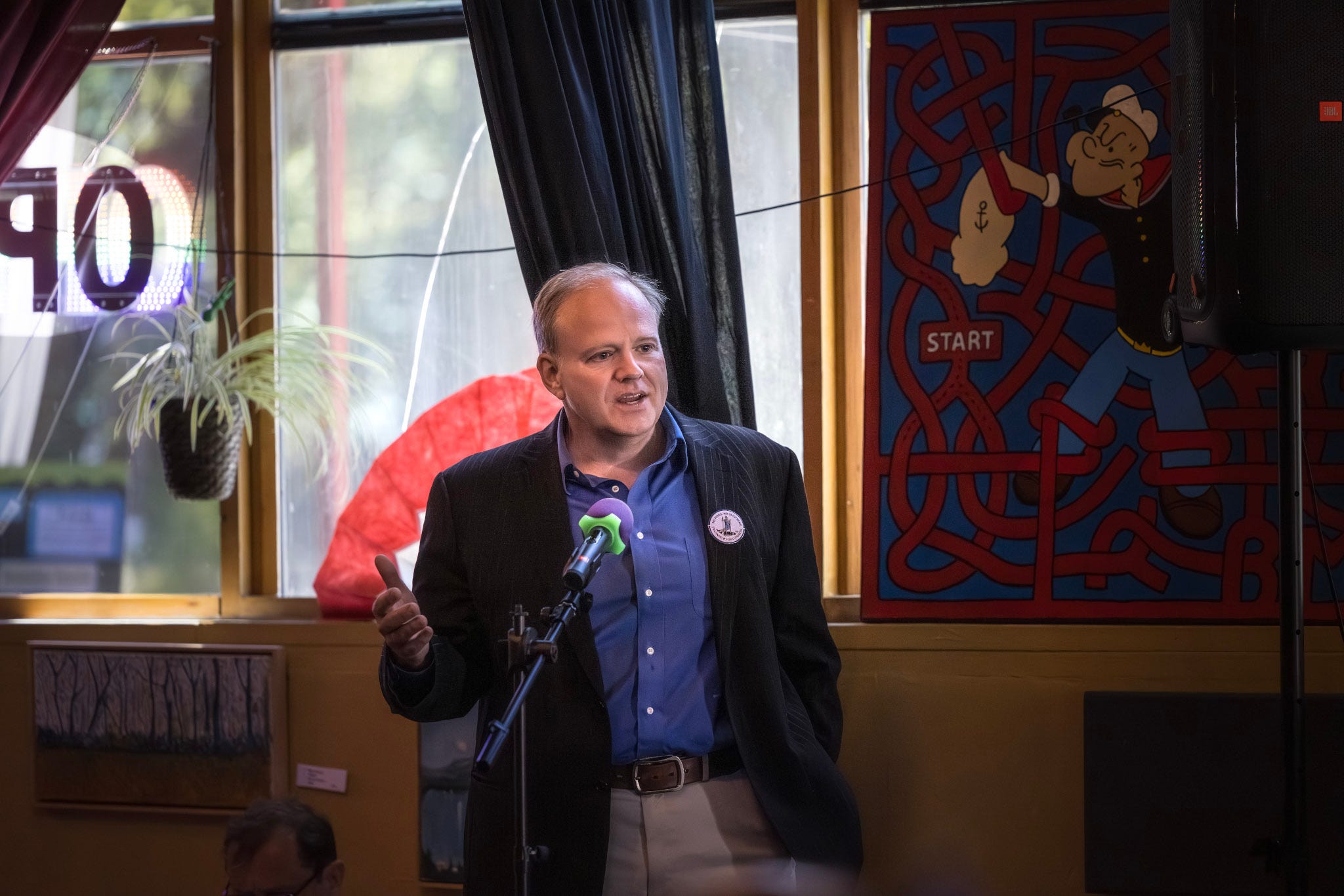
I’ve been promising to share some of the things I learned by running for office. I’ve distilled it into six lessons, and I’ll share them in six installments over the next month or so.
But first, here’s a tantalizing little news story I came across.
100% Human
Someone did a study recently to see how much of the internet is now written by artificial intelligence chatbots. The result, about 10%, seemed alarmingly high to me until I read the piece and realized it’s even more alarming than that. The 10% figure includes web pages created before the release of ChatGPT. In a sample of sites created after ChatGPT, about a third showed signs of being written by AI.
But there’s a big caveat. How do they take a sample of half a million web pages and sort through them to see what was created by AI? By using AI, of course! This study used a service called Pangram, which sends a thief to catch a thief, so to speak. It uses AI to search for telltale signs of AI in the grammar and diction of written text. How does it do this? Nobody knows. “Much like the chatbots people use to generate text with AI, the detection software is a black box.”
That said, one of the places where Pangram is showing up now is on the back end of Substack. Before I send out one of these newsletters, I can ask Pangram to scan for signs of AI, and I am unreasonably pleased when it always comes back “100% human.”
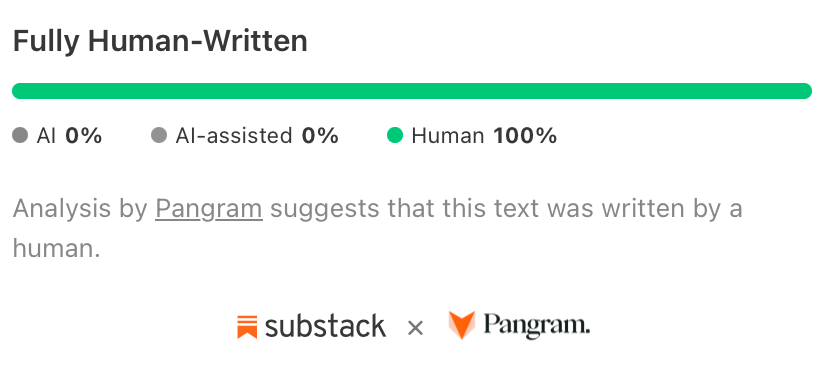
Is this verdict accurate and definitive? Definitely not. But it’s still nice to know the robots don’t think I’m one of them.
The point of all of this is that we may not know for sure if a third of all new websites are being created with AI, but you’ve probably noticed that a lot of unoriginal dreck and “AI slop” is being pushed out there. (I find it particularly bad on Facebook, which seems to be a deliberate choice by Mark Zuckerberg.)
By contrast, my promise to my readers is that this newsletter will always be fully human-written. Everything here is a thought from a human brain, free of AI sycophancy and hallucination. I’m giving it to you straight, based on knowledge I’ve checked out and verified based on a lifetime of experience.
It looks like that’s going to start being a luxury on the Internet.
It’s So Bad Even the Introverts Are Here
Starting last December, I made the jump from being a writer and commenter to being an actual participant in politics by running for the Democratic nomination for Congress in my Central Virginia district.
I did not succeed, losing to a candidate with much better name recognition.
This is not that unusual. A lot of people who try to go from pundit to candidate don’t succeed. Part of the reason more people don’t try is economic. If you write about politics for a living, the first thing you have to do when you run for office is to stop writing about politics for a living. Part of it is geographical. Most people in this business live near the big media centers of New York and Washington, where there are already well-entrenched incumbents. The only reason I thought I could attempt it is because I’m well outside the Beltway, in a district that had no clear front-runner (at first).
And yet, the pundit-to-candidate transition seems like a natural one, because we have a lot of the skills needed for the job: a deep knowledge of politics and of the issues—often much deeper than you’ll find from the average politician—and skills at writing and speaking. And I can tell you the temptation is enormous. It’s not so much about personal ambition as it is the frustration of spending decades on the sidelines watching the idiots in office make glaringly obvious mistakes and thinking: I could do so much better.
Yet few pundits make it. George Conway, a lawyer who used to work for Trump and then became a NeverTrump commentator and a mainstay at The Bulwark, got about the same percentage of the vote in his New York City primary as I did in mine. Kat Abughazaleh, who reached a huge online audience and raised far more money, got a bigger share of the vote but still barely topped 25%.
Part of the reason is that politics does in fact call for a different set of skills—a lot more networking and glad-handing among the rich and influential, and a lot more fundraising. I joked on the campaign trail that my inspiration was a sign I saw at a No Kings rally that said, “It’s so bad even the introverts are here.” To be a good writer, you have to look forward to spending hours at a time in a dark room alone just trying to understand an issue clearly. The sort of people we see on LinkedIn who have a monomaniacal focus on “networking” seem like a different species to us. But those are some of the skills you have to learn for politics.
Running for office also takes a lot of practice and preparation. I often felt like I was a theoretical physicist who was suddenly asked to build a nuclear reactor: You know all the theory, you know generally how things work, but you quickly find out everything you don’t know about the nuts and bolts of the process.
Politics Is a Time Warp
Above all that, politics takes time—not just time on the campaign trail, but time invested years beforehand. Winning usually takes a long and deep history of political connections in your district or community, and even if you haven’t entirely neglected that, you’re going to be up against people who have a really big head start.
