

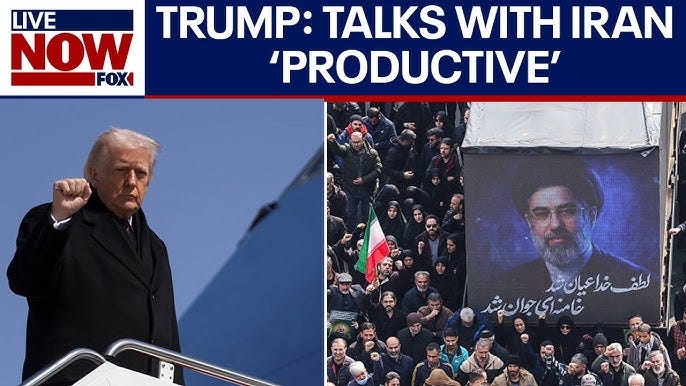
In news links here and in commentary from my campaign, I have already lightly covered the ongoing debacle of Donald Trump’s war again Iran. As I said early on, what makes me even angrier about this story is that I am a longtime Iran “hawk,” as my regular readers know well. I have been advocating for a leader who would finally do something bold and effective against the Iranian regime.
And then Donald Trump loudly claimed to do that, and—well, the monkey’s paw did its work.
I don’t normally do a hard-sell on subscriptions, but I’m rebuilding this newsletter after my brief adventure in electoral politics. Signing up will keep you informed about the often hidden stories behind big and important events—as you will see if you keep reading below—and it will also help provide a base for my advocacy of a rational alternative.
If you’re not already subscribed, please mash that button and sign up.
At my campaign site, I posted a thorough overview of how Trump’s war against Iran has failed. I’ll just give the bullet points.
I listed each of America’s stated or possible military objectives in the conflict.
Change the regime, or:
Install a friendly dictator.
End Iran’s support for terrorist proxies.
Destroy Iran’s missile and drone programs.
End Iran’s nuclear weapons program.
Keep the Strait of Hormuz open.
On each of these goals, we failed to achieve succss and on most of them, we are significantly worse off than we were before the war.
That was in June, and nothing has changed since then. All we’ve done since the first weeks of the war, really, is to go through a by-now familiar cycle in which Donald Trump issues dire threats against Iran, sometime follows them with a few airstrikes, then backs down and claims the Iranians have agreed to a new round of negotiations in which they will give in to our demands (see the image at the top of this newsletter, which is one of many such announcments). Nothing ever comes from these supposed negotiations, and the cycle begins again. Often, the whole thing begins and ends during a single weekend so it can be wrapped up before the markets open on Monday.
This is all just floundering. It is not an attempt to win the war or change its direction but an attempt to pretend the conflict is still ongoing so Trump doesn’t have to admit that it’s over and we lost.
The latest updates are that Iran is currently negotiating with Oman, the country on the other side of the Strait of Hormuz, to effectively set up a toll system that institutionalizes Iranian control. The Trump administration seems poised to accept this, which would be a de facto surrender, as Trump now says, “We are low-keying it” in the conflict with Iran.
I could go over many of the details of the administration’s bad decisions in this war, and I’ve tried to keep you abreast of them in my news link round-ups. But the root of the problem is the same as in every one of this administration’s prominent failures, the same one that led to the debacle of the reflecting pool.
Trump went with his gut, and nobody around him had the nerve to contradict him.
I suggest reading a long and in-depth report in the New York Times on the decision-making that led to the war. The upshot is that Trump was repeatedly warned that the plan was unrealistic, and he was repeatedly briefed on its risks. But he decided to do it anyway, and everyone in the administration acted in the way they were chosen and groomed to react.
Everyone deferred to the president’s instincts. They had seen him make bold decisions, take on unfathomable risks and somehow come out on top. No one would impede him now.
Keep that in mind because this report was built on leaks from insiders, who were clearly trying to disavow responsibility for the results, which had already turned out badly. That’s especially true for J.D. Vance. But the fact is that not a single one of them stuck his neck out to try to stop Trump from making this mistake. Consider this passage about Marco Rubio.
Mr. Rubio indicated to colleagues that he was much more ambivalent. He did not believe the Iranians would agree to a negotiated deal, but his preference was to continue a campaign of maximum pressure rather than start a full-scale war. Mr. Rubio, however, did not try to talk Mr. Trump out of the operation, and after the war began he delivered the administration’s justification with full conviction.
Who cares what he may have thought in private? What matters is what he actually did in public.
Remember this, because a lot of these people are going to try to rewrite that reality in the future.
The Venezuela Model
The more interesting aspect of Trump’s war in Iran is not its failure. Beneath that, there is the problem that a success, as he defined it, would arguable have been worse. The reason is that what Trump is trying to do in his foreign policy is fundamentally different from what the US has usually tried to do. I think it’s somewhat different from what we have ever tried to do, and it’s certainly different from what we have tried to do for at least a century.
With the exception of perhaps a few decades at the end of the 19th Century, American foreign policy has not been overtly imperialist. Certainly, from World War I through the Cold War, and beyond, we have justified our actions as a way of defending, supporting, and spreading “liberal democracy.” Leftists liked to complain about our policy of supporting “friendly dictators” as an alternative to Soviet-backed tyrants, but in the 1980s we put the skids under a bunch of them. We withdrew support from Ferdinand Marcos in the Philippines and Augusto Pinochet in Chile and encouraged democratic reforms from El Salvador to South Korea—and with excellent results. The pro-democracy idealism of the George W. Bush era was not his invention. It was the product, in many ways, of these previous successes.
The general idea is that America’s best interests and future security are best served by promoting liberal democracy and free trade—while ensuring that we serve as the military and diplomatic leader of the democracies and the economic center of the network of trade. This approach was not always well-implemented, but the idea is essentially correct.
Donald Trump has taken a fundamentally different approach. His policy is openly imperialistic, with himself as the emperor.
